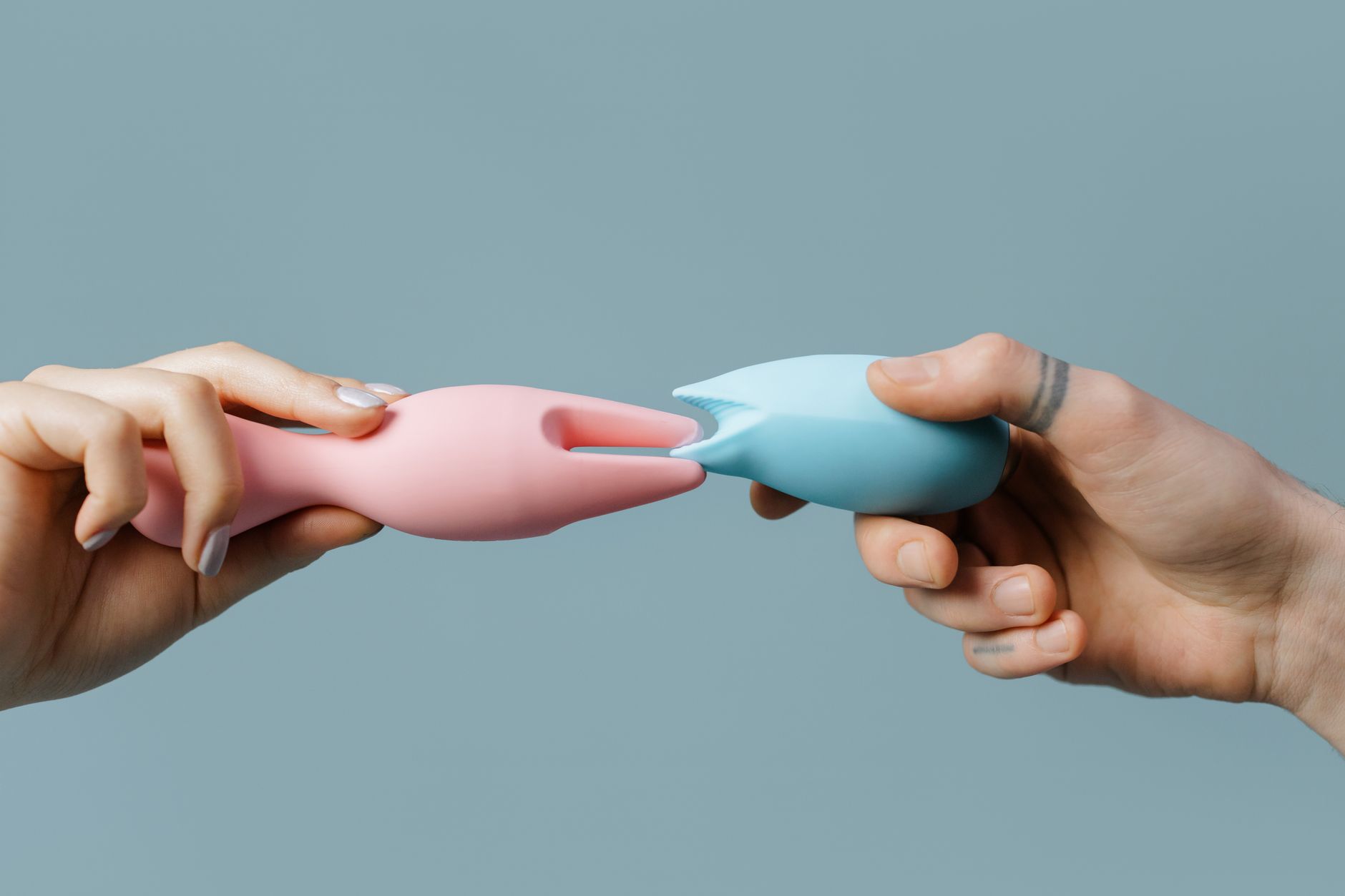
How to Use Lemon Vibrators When You Feel Self-Conscious About Pleasure
Shame and guilt are arousal killers. A therapist on why you freeze up, how lemon clitoral vibrators can actually help you past that resistance, and what rewiring feels like.
Let's be real: shame is not a feeling you experience above the neck. It lives in your nervous system. The moment you think "I shouldn't be doing this" or "What if someone finds out," your body registers threat. Your pelvic floor tightens. Blood flow redirects away from your genitals and toward your limbs, prepping you to run. Arousal flatlines.
You can have The Lem in your hand, the perfect pattern running, and your brain will still be louder than your body. That's not a problem with the toy. That's not even a problem with you. That's what happens when internal permission is missing.
Most of my clients who freeze up during pleasure were taught one of three things: that desire is shameful, that your body belongs to someone else (a partner, a parent, God, society), or that good people don't prioritize their own sensation. These aren't small messages. They're usually delivered early, reinforced often, and buried deep.
The tricky part is that shame doesn't announce itself. It doesn't say "Hi, I'm religious conditioning from childhood." Instead it whispers: "This is weird." "You're being selfish." "You should want this but you don't, so something's wrong with you." It disguises itself as truth.
In my practice, I've worked with people from every background who describe the exact same experience: they touch themselves, or a partner touches them, and suddenly they feel watched. Not by a real person. By an internalized voice. A parent, a religion, a culture, a partner's judgment. And the arousal just... stops.
This is counterintuitive, but stay with me. A vibrator isn't a solution to shame. Nothing external is. But air-suction clitoral vibrators like The Lem have one specific advantage when you're battling internal resistance: they reduce the cognitive load of performance.
Here's why. Manual stimulation requires you to pay attention to rhythm, pressure, positioning. Your brain is working. That gives the shame voice room to get louder. "Are you doing this right? Are you being weird? Hurry up. You're taking too long." The brain is still in control.
With The Lem, the work is delegated. You're not performing the stimulation; you're receiving it. That subtle shift in agency sometimes cracks open the space where pleasure can actually happen. Your job becomes only one thing: to notice sensation. To let your body respond. That narrowness is powerful when you're fighting your own mind.
The suction mechanism also feels fundamentally different from what most people masturbate with. It's not friction. It's a gentler, more diffuse stimulation. For people whose shame is tangled up with feeling "dirty" or "rough," that difference in sensation can short-circuit the shame response, at least momentarily.
But here's what I need to say clearly: The Lem isn't magic. You can't vibrate your way past internalized shame without also doing the psychological work.
Before you even pick up the toy, spend time with this question: Who told you that your pleasure was wrong? Write it down. Was it a parent's discomfort with bodies? Was it a religion? Was it growing up watching people who wanted things get punished? Was it a partner who made your desire feel like a problem they had to fix?
Just naming it matters. Shame thrives in silence. The moment you can say "Oh, that voice is my mother's judgment, not my actual belief," something shifts.
Then try this: Tell yourself explicitly, out loud if you can, "My pleasure is allowed." "I deserve to feel good." "My body is mine." This feels absurd the first time. The second time, a little less. By the tenth time, you might almost believe it.
If you're not past the shame yet, here's a practical approach:
Start in private, completely alone. Not during a partner encounter. This is research. You're learning what your body wants when no one else is watching and no external judgment is possible.
Use The Lem on the lowest setting first. Patterns 1 through 3. You're not trying to have an orgasm. You're trying to build tolerance for receiving pleasure without shame crashing the party. That's the whole goal. Orgasm is a bonus.
Focus hard on sensation, not performance. When the shame voice shows up (and it will), acknowledge it like a thought that isn't yours. "There's that voice again." Then redirect your attention to what you actually feel. The vibration. The warmth. What's different about this moment versus the shame narrative.
Set a time limit. Fifteen to twenty minutes. This contains the experience and makes it feel less like "I'm indulging in something forbidden" and more like "I'm doing a specific activity that's mine."
Do it multiple times. You're literally rewiring your nervous system. One session won't do it. Consistency matters. After five or six times, many people notice the shame voice gets quieter.
There's a specific moment that happens when the internal permission finally takes hold. Your breathing changes. Your body stops bracing. You might notice your hips move on their own, or your thighs relax, or suddenly The Lem feels ten times more pleasurable than it did five minutes ago.
That moment isn't the orgasm. That's the feeling of your nervous system deciding it's safe to want something. That it's safe to feel. That your pleasure isn't a threat.
Once that lands, everything shifts. The Lem goes from being something you use despite shame to something you use with genuine desire. And honestly, that's the real win. Not the orgasm. The permission.
If you're in a relationship and shame is tangled up with your partner's needs or judgments, that's a different layer. How to Use Lemon Clitoral Vibrators With a Long-Term Partner goes deeper into those dynamics, but here's the short version: you can't fix shame about pleasure while you're simultaneously managing someone else's comfort with it.
You might need to have a conversation. Something like: "I'm working on feeling better about my own pleasure. I need some space to explore that solo for a bit." A partner worth being with will get that. If they don't, that's actually useful information about the relationship itself.
Similarly, if you're Returning to Sex After a Long Relationship and you're carrying shame about your own desire that got wrapped up in someone else's expectations, solo exploration with The Lem is some of the best therapy available. Your body gets to remember what it wants when it's only answering to itself.
Completely normal. Shame doesn't disappear because you have a toy. It's a signal that your nervous system is still in protection mode. The vibrator is a tool; permission is the prerequisite. If disconnection persists after several solo sessions, it might be worth talking to a therapist who specializes in sexual health. Sometimes shame is layered with trauma, and that needs deeper work.
Most people notice a shift after five to eight sessions of solo, unrushed exploration with The Lem. But "quiet" doesn't mean gone. Shame usually has layers. You might process one layer, feel great for a few months, and then hit another layer tied to a different memory or belief. That's normal. Each layer you process makes the next one easier to recognize and move through.
Eventually, yes. But not at the start. The first permission needs to happen alone, where you're not managing anyone else's experience or judgment. Once you've built some internal permission solo, partner exploration becomes an extension of that, not a substitute for it. Trying to rewire shame in front of someone else is like trying to learn to swim while someone's criticizing your form. Much harder.
That's deep work that often needs more than a toy and willpower. A therapist who understands the specific cultural or religious context is invaluable here. But solo exploration with The Lem can still be part of your journey. You're not trying to destroy your beliefs; you're trying to create space where your body's wants and your beliefs can coexist, even if they're in tension. That coexistence is possible, and it starts with your body learning that pleasure isn't dangerous.
Orgasm isn't the goal here; permission is. Some people's nervous systems take longer to fully relax into pleasure. Some people are anorgasmic and that's just their physiology. If you're feeling sensation, if your body is responding, if arousal is building even slightly more than before, that's the progress. Orgasm might come later. It might not. Either way, your pleasure still counts.
If solo exploration over several weeks builds even a little more ease and sensation, you're on the right track. If you're consistently hitting a wall where your body completely shuts down, or if shame is tangled with trauma or abuse, that's clinical work. A sex-positive therapist or someone trained in trauma therapy can help you work through those deeper roots. The Lem is a tool for exploration; it's not a replacement for healing when the shame is severe.
Using a lemon clitoral vibrator when shame is blocking pleasure isn't about the vibrator. It's about claiming permission. It's about deciding that your body's sensations matter as much as anyone else's comfort. It's about slowly, persistently telling yourself the truth: "I deserve to feel good. My pleasure is allowed."
The Lem is just the physical reminder. The real work is internal. And that work, once you start it, changes everything.